Monday, March 2, 2009

Report from Mexico, D.F.

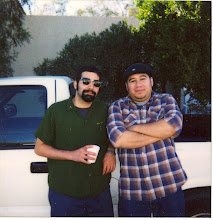
Here I am, on the hill of El Tepeyac, about 18 months after completing chemotherapy. Last time I was here, I was just starting to sprout little hairs on my body again.

My trip to D.F. was specifically to hold up my end of the manda Francisco made while I was in chemotherapy.

This photo was taken by Francisco Gonzalez on Feb. 13. That morning we rose early -- around 7 a.m. -- and marched from Calle Nezahualcoyotl to the metro station in the distrito historico to a stop just outside the basilica. We walked the route that is in the middle of the boulevard, a green pedestrian walk-way created to accomodate those making mandas and pilgrimages to la Virgen.

When we arrived, there were less than 40 people inside the basilica. After praying in the pews, I went down below to the floor below the tilma which displays the image of La Virgen that appeared to Juan Diego hundreds of years ago. To prevent lines backing up into the church auditorium, a moving floor -- like those moving walk-ways in airports -- is in place in front of the tilma.

After about 20 minutes riding back and forth on the moving floor to get a close look at La Tilma, we left. At the basilica gift shop, I paid for two masses: one to be said in the name of my father and another in Consuelo's name.

Then Francisco and I ascended the hill of Tepeyac. On our descent, we prayed at the Antigua Parroquia de Indios, the old chapel on the property. There, we prayed a full rosary to La Virgen.
That afternoon, I visited a brujo.


La Virgencita en la Tilma.

Saturday, February 21, 2009

Thursday, February 19, 2009

Services Monday and Tuesday

Services for Consuelo Aguilar will be held in Tucson this Monday night and Tuesday morning.
All I can recall is that Tuesday's service is scheduled for 10 a.m. at the cathedral -- St. Augustine's.
more to follow.

Tuesday, February 17, 2009

Your Thoughts and Prayers for Consuelo and the Aguilar Family


Consuelo passed away today.


Nate took this photo at Latino Fest in Whittier. She was in radiation treatment at the time.

Monday, February 16, 2009

headed back to Tucson

I was in Mexico City for about six hours by the time Francisco and I arrived to Chon's, a restaurant famous for its pre-columbian food located in the centro historico. The meal was a celebration of my birthday and my arrival, which was to pay thanks to La Virgen for her support during chemotherapy.

I'm not sure how it came up, but at some point Francisco told me that Consuelo is in a coma. I was shocked.

Suddenly I understood why I hadn't from heard from her. I'd sent text messages and called her throughout January and early February but I haven't heard from Consuelo since the holidays -- I think New Years Day, to be precise.

Last week, when Nate and I were having dinner, I asked if he had heard from her. It was the same with him.

When Francisco told me, I fought the urge to cry at the table. He knew how I'd take it and didn't want to be the one to break the news.

The next morning we rose around 7 a.m. and made our way to the basilica to make good on our manda, thank la Virgen and offer up new prayers.

When I returned to the United States on Sunday night, Nate picked me up at LAX. I told him what I'd learned almost immediately. He placed a call to Tucson and was told what I had learned a few nights earlier.

So we're headed to Tucson this weekend to see Consuelo.

In the meantime, a mass at the basilica in Mexico City will be said in her name. And from my trip to thank La Virgen, I brought back something for Consuelo's recovery.

Hopefully next year Consuelo and I will head to Mexico City to thank La Virgen for the recovery of another cancer survivor.

Monday, January 19, 2009

Stopped Reading "It's Not About the Bike"

I put down Armstrong's book late last week.

At the moment, I couldn't explain myself, but the reading was very unsettling.

I quit about 100 pages in, not long after the beginning of chapter five "Conversations with Cancer."

Armstrong and I went through the same treatment for testicular cancer: bleomycin, etoposide and cisplatin.

Here's how he (and his ghost writer) describe the drugs that comprised our treatment: "...they were so toxic that the nurses wore radioactive protection when handling them."

Reading that line triggered memories of plastics gloves over soft white flesh as I received slow, ten-minute injections of bleo, memories of the chemical cocktail arriving every session via a large, clear plastic bag. I recall how, to ensure I was receiving the right meds on the right day, nurses would ask my name, type of cancer and date of birth before each round. Nurses new to me were always a little startled at my age.

The nurses kept strict notes. Down to the minute the injections began.

I never asked about the toxicity of my meds, though one surgeon, hoping to convince me to go with a proposed invasive surgery, told me that the long-term side effects of chemotherapy is just now being discovered. Doctors say the darndest things...

It took me about six days to figure why Armstrong's book started to bother me. I realized it was a line I read on page 13.

This line: "...testicular cancer was a rare disease - only about 7,000 cases occur annually in the U.S."

Something about being part of such a small club bothered me, about being stricken with something rare. But I couldn't tell why, at least not for a few days. I always knew the numbers of those with the disease was small.

Then I started to unravel. I've recently acknowledged the severity of what I went through, in no small part through the pushing of my therapist.

The shock wasn't the number. I already knew that. It wasn't that I was part of small circle of people. I knew that too.

What was shocking, for the first time, is that the things that have become normal to me -- the memories, the scars, the mutilation, the tests, the questions, the fear with every pain near my genitalia, constant thoughts about cancer, cancer, cancer-- uh, it shocked me to realize that what has become normal to me isn't so for most other young men.

That my worry about setting up another blood test soon, because it felt like it had been too long, is a worry Matt and Armando don't have. That this wasn't just a rite of passage, like hazing in boy scouts or drinking in college.

That nearly two years later, none of this will go away. ever.

That in fact my experience and my thoughts are exclusive to a small group.

Reading, a year and a half later, that I am part of a minority of young men stricken with this disease...it didn't make any sense. It doesn't.

None what so ever.

It's not a poor me sentiment. Far from it.

Am I making sense?

The only way for me to move forward through this trauma is to rationalize it as "normal." As a survivor, I accepted the situation without questions and moved forward accepting what is, unwilling to look back on what was.

Now I am looking back and am frankly shocked at where I am.

Tuesday, January 13, 2009

no more beef with Lance Armstrong

okay.
i have to admit it on this blog: throughout the course of my cancer-survivorship, I stayed away from all things Lance Armstrong.
I wasn't interested in hearing about a super-star athlete and his triumphant journey from the face of death back to his bicycle seat. I openly question the amount of money going to his foundation and count myself as part of the anti-pink people who wonder aloud about the money going to maintain cancer foundations versus actual research.
I could not relate to a man with the resources at Armstrong's disposal when I got sick. I still can't.
Sorry, I didn't meet anyway at the clinic that dated Sheryl Crow.
But my therapist, an avid cyclist, has referred to Armstrong's book, "It's Not About the Bike: My Journey Back to Life," quite a few times since our sessions began.
So a few weeks ago, I found myself in the $1 bookstore in downtown Burbank.
I found Armstrong's book on the shelf. Last night, I finished the first section of Bolano's 2666.
This morning I decided to read Armstrong instead of move forward with Bolano. Out of curiosity, I suppose.
I found this passage on page 3:
"I've read that I flew up the hills and mountains of France. But you don't fly up a hill. You struggle slowly and painfully, and maybe, if you work very hard, you get to the top ahead of everybody else.
Cancer is like that, too."
Damn. Damn that's real.
Writing is like that. Playing an instrument is like that. And chemotherapy was very much like that.
I am always surprised by peoples reactions to my treatment and the attitude I took during those two and a half months of chemotherapy.
There was nothing heroic about my actions.
It was what you do to survive. Everyone in the clinic had the same attitude.
In fact, some more so than others.
I'll never forget that old guy with lung cancer. He didn't like to take his chemo. sitting down, so he'd hang his meds on a mobile I.V. stand and wheel around the clinic. A few times he checked on me.
That man is one of my heros. I can relate to him. Not Armstrong.
But that doesn't mean I can't learn from Armstrong's book.